Showing posts with label People. Show all posts

February 15, 2019

[Obituary] Former "Comfort Woman" and Human Rights Activist Kim Bok-dong


Kim Bok-dong was born in 1926 in Yangsan, South Gyeongsang Province. After completing the fourth grade of elementary school, she helped out with household chores until the age of 15. Her mother had told her stay close to home because “the times were strange.”

One day in 1941 – she can’t remember if it was the spring or the fall – Japanese people in yellow uniforms without rank badges came to her house, accompanied by her village leader and another official. Kim was told she needed to work for three years at a factory making army uniforms – and if she didn’t go, her family would be kicked out of their house and their property seized.

Figuring that it wouldn’t kill her to work at a factory, Kim told her mother she would go. At the age of 15, she was taken to Taiwan and then on to a Japanese military unit based in China’s Guangdong Province. How different her life would have been if she hadn’t gone with the Japanese back in 1941!
READ MORE

March 17, 2017

Korea News Analysis Featured on Democracy Now!


PBS news program Democracy Now! (hosted by Amy Goodman) featured, on March 13,  extensive coverage and interviews on developments in South Korea and tensions with North Korea. Guests were activist Christine Ahn and well-known Korea scholar Prof. Bruce Cummings. See videos (above) or transcripts (part 1, part 2).

August 12, 2016

Petition Campaign in Opposition to the Deployment of THAAD in South Korea Surpasses 100,000

The "We the People" whitehouse.gov petition campaign in opposition to the deployment of the THAAD anti-missile defense system in South Korea has surpassed the 100,000 threshold mark needed to obtain an official response from the White House on the issue.

The petition campaign was initiated by Korean Americans based in the Washington, DC area and spread across the U.S., and the momentum intensified as Koreans in South Korea joined in, including citizens of Seongju where the deployment will take place,  signifying widespread opposition to the move by the South Korean government.


April 19, 2016

Filmmaker Dai Sil Kim-Gibson's New Documentary on North Korea


“People are the Sky” director on documenting meanings of home, family

In the documentary “People are the Sky”, filmmaker and writer Dai Sil Kim-Gibson returns to her birthplace in North Korea after the death of her Iowa-born husband Don. Kim-Gibson, with the goal of discovering what home truly means, finds a country where people live in peace and harmony. READ MORE

March 11, 2016

Protest on the Korea-Japan "Comfort Women" Announcement


The 1221st "Wednesday Protest" took place in front of the Japanese embassy (special protest in Washington, DC) with survivor and delegation from South Korea on the "comfort women"/military sex slavery issue. The following is the statement from the rally.


We Denounce the Korea-Japan Announcement on the “Comfort Women” Issue

The military sexual slavery (“comfort women”) system perpetuated by the Japanese military during the World War II in Asia was a war crime committed by the wartime Japanese government, and it is clearly sex crime and human rights violation against women (mostly Korean), including minors aged 13 to 16.

To this day, the Japanese government has made statements on this issue which attempt to whitewash its own responsibility and the coercive nature of the abusive system. The recent Korea-Japan joint announcement on this issue does not drift afar from this.

The Japanese government needs to admit the coercive nature of the “comfort women” mobilization as historical accuracy and provide its legal responsibility and direct reparations – only then will there be sincerity in its apology and lead to the true recovery of honor and dignity of the surviving victims.

We also denounce the diplomatic folly by the Park Geun-hye government of South Korea for reaching this agreement without consultation with the survivors, that does not include official apology from the Japanese government, that yielded to the Japanese pressure on possibly removing the statue (which depicts a victim) across from the Japanese Embassy in Seoul, and agreeing to “irreversible” clause that will prevent future settlements on this issue. Many Korean citizens have voiced strong anger and the survivors have proclaimed this agreement as null and void.

In solidarity with the continuing effort of the survivors on this issue, we will continue to push for full and sincere apology and legal responsibility from the Japanese government.

March 10, 2016
Participants of the 1221st Wednesday Protest, in front of Japanese Embassy in the USA

Contact: nabiusadc@gmail.com

November 6, 2015

The Legacies of the Korean War

New Resource:The Legacies of the Korean War (http://legaciesofthekoreanwar.org/)

Launched in September 2015 at UC Berkeley.  Includes video, audio, and text oral histories, Korean War Timeline, comprehensive Additional Resources, scholar essays, and much more.  

[From the site description]

In the United States, the Korean War, known as the “forgotten war,” more often than not is commemorated as a matter of national security between this country and South Korea. Seldom are the legacies of this brutal war recalled from a human-centered perspective. Rarely is attention given to the fact that, some several decades later, no peace process has brought the Korean War to a close. Korean American war survivors are now in their eighties and nineties, and the time is ripe to foreground their memories as vital to both the historical record and community reflection. Not just a geopolitical reality but an ongoing tragedy, the war’s irresolution has been borne out in the lives of aging Koreans in the diaspora, many of whom witnessed the ruin of their hometowns, were separated from their loved ones, were orphaned, were pressed into military service, and have longed for decades to be reunited with family in North Korea.

For many years, memory of these experiences was suppressed, pushed to the margins of official Korean War histories and silenced within Korean American communities fractured by Cold War divisions. But as survivors age and pass away and second- and third-generation Korean Americans seek to understand their historical origins, these often-painful memories stand as testaments not only to the generational trauma of war, but also to the strength and heart of the Korean American community.

This archive seeks to honor and to give voice to these memories and the hopes of the Korean American community for peace and reunification in Korea.

May 28, 2015

Marching Towards Peace In Korea


By Tim Shorrock in PoliticoMagazine 

On Sunday [May 24, 2015], Gloria Steinem, looking radiant but tired in a white dress traditionally worn by Korean women, walked into a room packed with reporters and photographers at the Customs, Immigration and Quarantine building in Paju, South Korea, just a mile from the North Korean border.

Gathered around the American feminist icon were 30 women from 15 countries who had just accomplished what only two foreign groups had ever done before—cross the demilitarized zone dividing the communist North from the capitalist South. They were greeted in the south by hundreds of women and peace and unification activists from a country long divided by war and 60 years of tension.  Read more:

May 15, 2015

Korean Atomic Bomb Victims


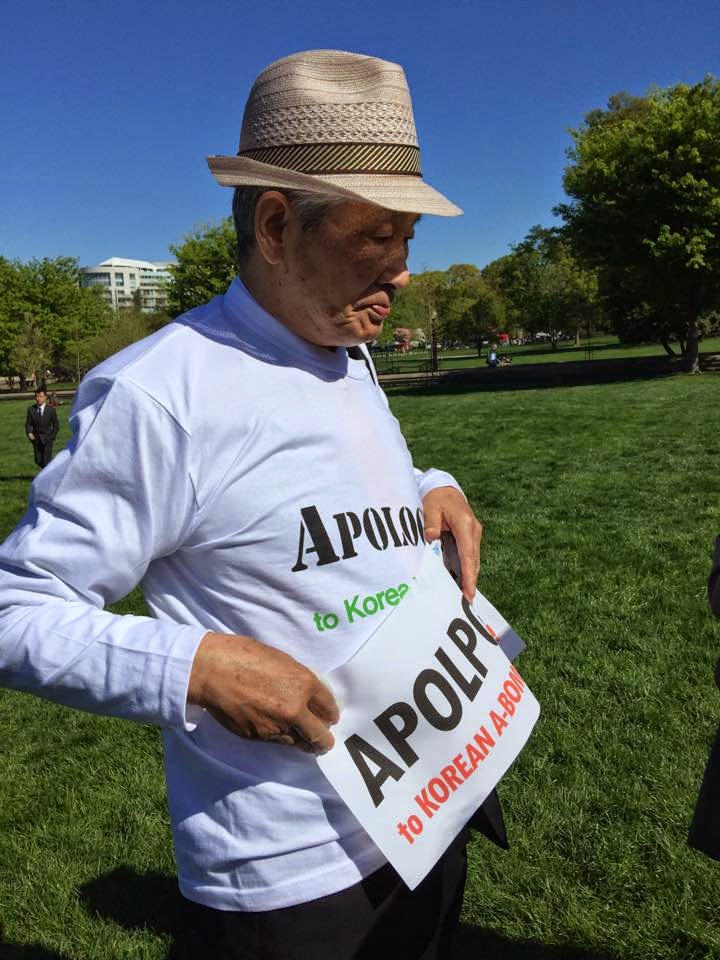
    Not many know that more than one seventh of WW II atomic bomb victims were Korean colonial subjects, most of whom were forced workers in Japanese military factories during the war. Korean "hibakusha" (atomic bombing survivor) were the forgotten people -- not compensated by the Japanese government when Japanese A-bomb victims were compensated, and neglected by the Korean government, as they were not included in the reparations that Japan gave to South Korea when the two countries normalized relations.  They are forgotten victims of colonialism and war like the military sex slaves ("comfort women"). 

Tourism in North Korea


[From KoreAm, by Mark Edward Harris]

Several years ago, Andrea Lee traded a desk job as a corporate attorney in New York City to head Uri Tours, a New Jersey-based travel company founded by her family a decade ago, which organizes tours to North Korea. As its CEO and occasional tour leader, the 33-year-old Lee helps curious individuals see what life is like north of the 38th parallel on the divided Korean peninsula.
Although widely perceived as a sealed-off nation closed to foreign tourists, North Korea permits group and even private travel by citizens of any country other than South Korea who book through a tourism partner-provider. While the U.S. Department of State strongly recommends against travel by U.S. citizens to the Democratic People’s Republic of Korea, as the country is officially known, there appears to be no adverse impact on Uri’s business. READ MORE

March 14, 2015

Female peace activists say they’ll walk across the DMZ


From The Hankyoreh Newspaper in Seoul, Korea: http://english.hani.co.kr/arti/english_edition/e_national/682155.html

Eyes are on Korea after a group of well-known female peace activists announced they will walk across the DMZ on May 24 for peace on the peninsula. The event suggests that women around the world are becoming more involved in the Korean Peninsula, which remains trapped in the Cold War even 70 years after the end of World War II.
In its coverage of the press conference for the event, which was held at the UN headquarters in New York on Mar. 11, the Associated Press said that “prominent women” were “making a dramatic statement in Korean relations.”
Along with two recipients of the Nobel peace prize - Mairead Maguire and Leymah Gbowee - women from a variety of backgrounds will be joining in the walk, including writers, scholars, filmmakers, and humanitarian activists. Most of the 30 participants, who hail from 12 countries, will be paying their travel expenses out of pocket.
Gloria Steinem, 81, regarded as an icon of the women’s movement in the US, drew attention by signing on as honorary co-chair of the event.
Steinem, who played a leading role in the feminist movement in the US in the 1960s and 1970s and was active in social issues and the peace movement after that, received the Presidential Medal of Freedom in 2013, the greatest honor that the US President can bestow on a private individual.
Steinem has taken great interest in the event, as her attendance at the press conference suggests. “It’s hard to imagine a more physical symbol of the insanity of dividing human beings than this zone. To me, to walk across it, has huge, huge, huge importance,” Agence France-Presse quoted her as saying.
Steinem’s deep interest in Korean Peninsula issues reportedly goes back to the sad story of a high school friend who was received a draft notice to fight in the Korean War.
“The friend’s father had suffered from trauma in the Second World War, and when he saw his son’s draft notice, he decided he couldn’t allow him to go to war,” explained Chung Hyun-kyung, a professor at New York’s Union Theological Seminary and member of the event’s executive committee. “So he killed his son and then himself.”
“Steinem noted that women had made a big contribution to ending conflict in Northern Ireland and Liberia, and she asked why that wouldn’t work on the Korean Peninsula too,” Chung added.
Abigail Disney, granddaughter of Walt, began making movies after meeting the Liberian female peace activist Leymah Gbowee in 2006. In 2008, she shared the story of the country’s peace movement with “Pray the Devil Back to Hell,” a documentary about Gbowee.
Other participants included Medea Benjamin, co-founded of the leading women’s anti-war group Code Pink, and Ann Wright, a former US Army colonel who resigned from the State Department in 2003 in protest of the Iraq War.
Among the Korean and Korean-American participants joining them were Rutgers University professor Suzy Kim, Korea Policy Institute co-founder Christine Ahn, Chung, and women’s rights activist Kim Ban-a.
Foreign nationals don’t need approval from the South Korean government to visit North Korea, but they would need to apply with the UN Command to pass through the DMZ. Foreign nationals traveling between North and South Korea must pass through South Korean government immigration procedures.
“If we are provided with specific plans, including their course while traveling in North Korea, then it’s a matter for discussion with the relevant agency,” a Unification Ministry official explained.

March 1, 2013

Park Geun-hye Becomes South Korea's President


Park Geun-hye, the eldest daughter of the late dictator Park Chung-hee (18 years of iron-fisted, repressive rule), has assumed the presidency of South Korea. She has returned to the Blue House (South Korea's presidential residence/office) after 34 years, having served as the First Lady after her mother was assassinated.

South Korea has changed drastically since her last stay in the Blue House, as hard-earned democratization took a firm hold on the Korean society and politics, with a 5-year, single-term presidency in place.  She has been elected in a free election, thanks to the conservative base, with a promise to rejuvenate the economy and implement some welfare programs, despite her being the most conservative candiate of the presidency. She has also promised to pursue a different approach to North Korea than the confrontational approach of her predecessor Lee Myung-bak -- this will be tested in coming days as tensions mount with North Korea.

Much are expected from her presidency, as she needs to shed the legacy of her father's authoritarian rule in order to avoid the label "daughter of dictator" and pursue receptive policies that will bring together the fragmented and politically polarized South Korean populace.

February 28, 2013

Dennis Rodman in Pyongyang


Who would have thought -- North Korean leader Kim Jong Un laughing side-by-side with Dennis Rodman of the Chicago Bulls fame, at a friendly basketball match in Pyongyang. Rodman is travelling in North Korea with members of the Harlem Globetrotters and a US cable news team. And one of the first tweets coming out of North Korea now that North Korean authorities have allowed the use of smartphones by foreigners, with internet access:  "Um ... so Kim Jong Un just got the [cable news team] crew wasted ... no really, that happened" came out of the reception given by Kim to American visitors.  Fun respites amidst war games and counter threats between the U.S. and North Korea -- sort of reminds of the song by the group War, "Why Can't We Be Friends?"

January 10, 2013

Google's Top Man in Pyongyang


Of all the unusual and unexpected foreign visitors to North Korea, Google's executive chairman and tech guru Eric Schmidt's visit this week to Pyongyang has raised a plenty of questions. Though this is not portrayed as a Google company trip, the very presence of high-profile Schmidt (and his interest and willingness to personally visit North Korea) highlights the growth and potentials of cyber technology in North Korea. 

Schmidt is accompaying veteran diplomat and former New Mexico Governor Bill Richardson, on a humanitarian trip.  The trip clearly perturbed the U.S. State Department, which maintains a rigid policy of isolating North Korea as punishments for long-range missile/rocket testings. But there are also benefits to this kind of civilian-initiated diplomacy as wider contacts with North Korea will likely bring new avenues and opportunities of mutual cooperation and a path of understanding towards resolutions of contending political and military issues.

November 11, 2011

A Korean-American Becomes U.S. Ambassador to South Korea

Sung Kim, a "1.5 generation" Korean-American, is the new U.S. ambassador to South Korea (photo showing his family's arrival in Seoul), marking the first time that a Korean-American has taken this post. Kim hadserved as a Korea expert in the State Department. He was also a special envoy to the six-party talks, which now puts him in a good position on the ground in the Korean Peninsula to help foster an atmosphere for possible renewal of the talks aimed at nuclear disarmament and regional security in Northeast Asia.

October 26, 2011

A Civic Activist Becomes the Mayor of Seoul

Park Won-soon (second from the right on the photo, with supporters from other opposition party leaders) -- human rights lawyer, pro-democracy activist, and a leader of South Korea's grassroots civil society organizations -- was elected as the next mayor of Seoul.

This election was significant in many ways in that 1) a political novice and independent candidate won a major election, bypassing more well-known candidates from the established parties; 2) the opposition parties fielded a unified candidate (by supporting a non-affiliated candidate) which helped prevent splintering of votes that arose in the past elections with the usual array of many opposition candidates; 3) it is an indicator of the populace's dissatisfaction with the ruling Lee Myung-bak government and its policies that will impact upcoming general and presidential elections in 2012; 4) the younger generations have voted strongly for Park, suggesting that they yearn for change from the established politics and economic inequities and hardships.

With his long experiences in civic activities and citizen watchdog groups, Park will be in a good position to promote genuine and popular reforms based on true fairness and social justice.

April 23, 2011

Jimmy Carter Heads to North Korea Again

Former President Jimmy Carter is heading to North Korea again (his third trip) next week with three former world leaders (belonging to a group called "The Elders"), to address tension in the Korean Peninsula and food shortage in North Korea. Hopefully, their efforts will bring some improvements in the current situation.

December 16, 2010

Bill Richardson (and Wolf Blitzer) in Pyongyang

New Mexico Governor Bill Richardson is in Pyongyang for talks with North Korean officials. Richardson is in good terms with North Koreans, so the discussions, though unofficial, will help in finding steps to reduce current tensions on the peninsula. News anchorman Wolf Blitzer of CNN-TV is also in the delegation, bringing a high-profile coverage to Pyongyang.

November 28, 2010

Growing Voices for Peace in Korea

In response to the tense military situation in the Korean peninsula and dangers of further escalation, voices for peace and engagement are growing in the U.S. Demonstration for peace was held in front of the White House on November 27 (above photo) with participation by peace activists (including Korean War and Vietnam War veterans) and concerned Korean-Americans; other rallies are planned for New York City, San Francisco and Los Angeles.

U.S.-based organizations that have mobilized for peace in Korea include the National Campaign to End the Korean War, the Alliance of Concerned Scholars about Korea, the Korea Policy Institute, and Nodutdol, among others. Calls for engagement with North Korea for a peaceful settlement abound in the media: Tim Shorrock on Democracy Now, John Feffer on The Huffington Post. Those U.S. experts who have recently returned from a visit to North Korea (revealing a new North Korean uranium enrichment program) are calling for engagement as well: Siegfried Hecker, Bob Carlin and John Lewis. Peace organizations in South Korea as well as civil society groups are also calling for dialogue and a peaceful settlement.

September 16, 2010

Jimmy Carter Explains his Trip to North Korea

Though former president Jimmy Carter went to North Korea recently on an unofficial capacity, to free an imprisoned American, he did talk to high-ranking officials in Pyongyang, in a way to test the waters for a possible breakthrough in the current deadlock with the nuclear disarmament/security negotiations. In an op-ed piece in The New York Times, Carter believes North Korea is willing to come back to the negotiating table. He concludes: "A settlement on the Korean Peninsula is crucial to peace and stability in Asia, and it is long overdue. These positive messages from North Korea should be pursued aggressively and without delay, with each step in the process carefully and thoroughly confirmed."

September 15, 2010

English Women's Soccer Team Tours North Korea

While North Korea is portrayed as isolatd from the West, an English women's soccer team is touring North Korea as part of sports and cultural exchange.

Middlesbrough Football Club (MFC) women's team (photo: manager Marrie Wieczorek) has been invited by the British Embassy in Pyongyang in recognition of the strong bonds Middlesbrough has shared with North Korea since the 1966 World Cup in England when the townsfolks became fans of the North Korean team during the team's remarkable feat at the games. The 1966 North Korean team paid a return visit to Middlesbrough in October 2002.

Nick Bonner, who made a documentary The Game of their Lives about the 1966 World Cup team with his business partner Dan Gordon, and who helped arrange the women team's visit to North Korea, said: “There is no doubt about it that [North Koreans] came to England in 1966 as the enemy, as many English people had fought in the Korean War, but the people of [Middlesbrough] adopted them as their team and they have never forgotten that.”

Such people-to-people exchanges can help bring reconciliation between former enemies.