Seoul has been selected as South Korea’s candidate city to bid for the 2032 Summer Olympics jointly with North Korea. On the afternoon of Feb. 11, the city of Seoul announced that it had been selected at a general meeting of Korean Sport and Olympic Committee (KSOC) representatives at the Jincheon National Training Center in North Chungcheong Province as the South Korean city that will bid for the 35th Summer Olympics in 2032. Seoul had been in competition with Busan, but persuaded the representatives to favor it based on its symbolism as South Korea’s leading city, the competitiveness of its urban infrastructure, and its international capacity. READ MORE
Showing posts with label Inter-Korea relations. Show all posts
February 15, 2019
Seoul selected as S. Korean city to co-host 2032 Olympics with North Korea’s Pyongyang
Seoul has been selected as South Korea’s candidate city to bid for the 2032 Summer Olympics jointly with North Korea. On the afternoon of Feb. 11, the city of Seoul announced that it had been selected at a general meeting of Korean Sport and Olympic Committee (KSOC) representatives at the Jincheon National Training Center in North Chungcheong Province as the South Korean city that will bid for the 35th Summer Olympics in 2032. Seoul had been in competition with Busan, but persuaded the representatives to favor it based on its symbolism as South Korea’s leading city, the competitiveness of its urban infrastructure, and its international capacity. READ MORE
South Korea to spend $16 billion in border areas with North Korea for next decade
South Korea's government said on Feb 7 that it will spend 13.2 trillion won (S$15.9 billion) in border areas with North Korea for the next decade. The money, including 5.4 trillion won from the central government, 2.2 trillion won from local governments and 5.6 trillion won from the private sector each, will be spent on 225 projects in inter-Korea border areas by 2030.
The projects were aimed to establish foundation for inter-Korea exchange and cooperation, lay the groundwork for a balanced regional development, stimulate ecological peace tourism in border areas and expand social infrastructure, according to the Ministry of the Interior and Safety. READ MORE
December 12, 2018
Soldiers Shake Hands in the DMZ
Instead of pointing guns at each other, soldiers from North and South Korea shook hands at the demarcation line in the Demilitarized Zone that separates the two sides of Korea. These sort of things happened only in imaginative Korean movies, but is now a solid reality. Hope this welcoming momentum of genuine peace continues and spills over to multilateral negotiations, agreements and implementations to ensure lasting peace in the Korean Peninsula.
Fact Check: This piece erroneously says the Demilitarized Zone (DMZ) was created in 1948. Actually, the 38th Parallel was the arbitrary boundary proposed by the U.S. for zonal occupation of liberated Korea at the end of WWII and accepted by the USSR in 1945 that remained as a boundary until the war broke out in 1950. The DMZ was created in 1953 as a part of the Korean War armistice agreement, which still is in effect pending a long-promised peace treaty.
November 12, 2018
"Produce Diplomacy": Another Sign of Warming Inter-Korean Relations.
South Korea has airlifted 200 tons of famous tangerines from Jeju Island to North Korea in return for shipments of pine mushrooms by the North in September. Are we seeing a "Produce Diplomacy" at work? It is another sign of warming inter-Korean relations. READ MORE
Inter-Korean Sports Cooperation Bear Results
South and North Korea agree to integrate respective branches of Taekwondo (natural thing to do as taekwondo is a universal Korean tradition that came way before the division of Korea) -- another fruit of inter-Korean rapprochement, along with the proposal for a joint bid for the 2032 Olympics.
Read more.
October 26, 2018
Inter-Korean Natural Gas Pipelines Envisioned
Another positive development in the Korean Peninsula that will surely help in defusing tensions in the region, similar to the planned inter-Korean rail and road links, that may lead to the whole peninsula's direct linkage to the Eurasian landmass. READ MORE
Inter-Korean Military Cooperation Expands
The two sides of Korea are moving forward rapidly and widely with the demilitarizing process in the Demilitarized Zone (DMZ), making the DMZ live up to its name for the first time since its inception in 1953. The next logical step is to officially end the Korean War by replacing the current armistice agreement with peace treaty, READ MORE
September 19, 2018
Inter-Korean Rapprochement Advances with Third Moon-Kim Summit
Great progress towards (officially and mutually) ending the Korean War and a viable peace settlement in the Korean Peninsula has been achieved with the third inter-Korean summit between President Moon Jae-in of South Korea and Chairman Kim Jong-un of North Korea. Wide-ranging inter-Korean cooperation in military, economic, cultural/sports, and humanitarian affairs are in the works. Hopefully these developments will foster quicker Washington-Pyongyang and Tokyo-Pyongyang rapprochements.
Pyongyang Joint Declaration of September 19, 2018 [Full Text]
Moon Jae-in, President of the Republic of Korea and Kim Jong-un, Chairman of the State Affairs Commission of the Democratic People's Republic of Korea held the Inter-Korean Summit Meeting in Pyongyang on September 18-20, 2018.
The two leaders assessed the excellent progress made since the adoption of the historic Panmunjeom Declaration, such as the close dialogue and communication between the authorities of the two sides, civilian exchanges and cooperation in many areas, and epochal measures to defuse military tension.
The two leaders reaffirmed the principle of independence and self-determination of the Korean nation, and agreed to consistently and continuously develop inter-Korean relations for national reconciliation and cooperation, and firm peace and co-prosperity, and to make efforts to realize through policy measures the aspiration and hope of all Koreans that the current developments in inter-Korean relations will lead to reunification.
The two leaders held frank and in-depth discussions on various issues and practical steps to advance inter-Korean relations to a new and higher dimension by thoroughly implementing the Panmunjeom Declaration, shared the view that the Pyongyang Summit will be an important historic milestone, and declared as follows.
1. The two sides agreed to expand the cessation of military hostility in regions of confrontation such as the DMZ into the substantial removal of the danger of war across the entire Korean Peninsula and a fundamental resolution of the hostile relations.
① The two sides agreed to adopt the "Agreement on the Implementation of the Historic Panmunjeom Declaration in the Military Domain" as an annex to the Pyongyang Declaration, and to thoroughly abide by and faithfully implement it, and to actively take practical measures to transform the Korean Peninsula into a land of permanent peace.
② The two sides agreed to engage in constant communication and close consultations to review the implementation of the Agreement and prevent accidental military clashes by promptly activating the Inter-Korean Joint Military Committee.
2. The two sides agreed to pursue substantial measures to further advance exchanges and cooperation based on the spirit of mutual benefit and shared prosperity, and to develop the nation's economy in a balanced manner.
① The two sides agreed to hold a ground-breaking ceremony within this year for the east-coast and west-coast rail and road connections.
② The two sides agreed, as conditions ripe, to first normalize the Gaeseong industrial complex and the Mt. Geumgang Tourism Project, and to discuss the issue of forming a west coast joint special economic zone and an east coast joint special tourism zone.
③ The two sides agreed to actively promote south-north environment cooperation so as to protect and restore the natural ecology, and as a first step to endeavor to achieve substantial results in the currently on-going forestry cooperation.
④ The two sides agreed to strengthen cooperation in the areas of prevention of epidemics, public health and medical care, including emergency measures to prevent the entry and spread of contagious diseases.
3. The two sides agreed to strengthen humanitarian cooperation to fundamentally resolve the issue of separated families.
① The two sides agreed to open a permanent facility for family reunion meetings in the Mt. Geumgang area at an early date, and to promptly restore the facility toward this end.
② The two sides agreed to resolve the issue of video meetings and exchange of video messages among the separated families as a matter of priority through the inter-Korean Red Cross talks.
4. The two sides agreed to actively promote exchanges and cooperation in various fields so as to enhance the atmosphere of reconciliation and unity and to demonstrate the spirit of the Korean nation both internally and externally.
① The two sides agreed to further promote cultural and artistic exchanges, and to first conduct a performance of the Pyongyang Art Troupe in Seoul in October this year.
② The two sides agreed to actively participate together in the 2020 Summer Olympic Games and other international games, and to cooperate in bidding for the joint hosting of the 2032 Summer Olympic Games.
③ The two sides agreed to hold meaningful events to celebrate the 11th anniversary of the October 4 Declaration, to jointly commemorate the 100th anniversary of the March First Independence Movement Day, and to hold working-level consultations toward this end.
5. The two sides shared the view that the Korean Peninsula must be turned into a land of peace free from nuclear weapons and nuclear threats, and that substantial progress toward this end must be made in a prompt manner.
① First, the North will permanently dismantle the Dongchang-ri missile engine test site and launch platform under the observation of experts from relevant countries.
② The North expressed its willingness to continue to take additional measures, such as the permanent dismantlement of the nuclear facilities in Yeongbyeon, as the United States takes corresponding measures in accordance with the spirit of the June 12 US-DPRK Joint Statement.
③ The two sides agreed to cooperate closely in the process of pursuing complete denuclearization of the Korean Peninsula.
6. Chairman Kim Jong-un agreed to visit Seoul at an early date at the invitation of President Moon Jae-in.
May 1, 2018
Fast Progress on Inter-Korean Thaw After the Summit
Fast progress on inter-Korean thaw after the summit:
1) Dismantling of provocative border propaganda speakers
2) Synchronizing time zone for the two sides of Korea -- benefitting upcoming inter-Korea exchanges and commerce
3) Working towards linking railway between the two sides, enabling future continous land trip from South Korea to Europe.
4) Talks of multiple unfied sports teams at the upcoming Asian Games
5) Talks of reviving inter-Korean liason/business office at the Kaesung industrial complex
6) Working to arrange reunion of separated families during the August 15 Libereation Day period
7) Upcoming high-level military talks to reduce military tension, including making the contested and volatile sea border area in the West Sea as "peace zone" for mutual fishing activities
And ---
-- Unprecedented 80% approval rating for President Moon after the summit
-- Extensive and transparent coverage of the summit in the North Korean state media
-- Big sigh of relief for Koreans, especially those living close to the border
The Breakthrough Moon-Kim Summit
A picture speaks a thousand words .... Remarkable photo, among many, of the historic inter-Korean summit that took place at the Panmunjeom/Demilitarized Zone, symbolizing the will of the two sides of Korea to officially end the Korean War and to propel towards a long-lasting peace settlement in the peninsula.
The border crossings at the Panmunjeom reminds of the famous words "Whose land is this, if Koreans cannot move back and forth [between the south and the north] in their own land?" -- popularized after the artificial division of Korea after the World War II.
Now, Koreans have taken the bold initiative in formally ending the Korean War and breaking down barriers to a lasting peace settlement.
In normal times, all those wishing to cross the border line at the Panmunjeom need to get permission from the US commander in charge of the nominal Korean War-era UN Command role. The two Korean heads of state ignored that archaic protocol by casually stepping back and forth on the border line. In fact, during the summit, no US soldiers were in sight at the Panmunjeom.
Koreans have taken ownership of the narrative of their own future. The world should respect that and ensure that true peace prevails in the Korean Peninsula.
February 22, 2018
Renewing Thaw in the Korean Peninsula
Ten years have passed since the last thaw in inter-Korean relations, brought about by the "sunshine" policies. This photo shows a child in South Korea painting on a railroad track that intended to connect the two sides of Korea by rail, but that never materialized due to two successive conservative South Korean governments that put cold war on the thawing relations. Now, another opportunity has risen that gives renewed hope for a peaceful resolution in the Korean Peninsula.
January 10, 2018
Two Sides of Korea Are Shaking Hands Again
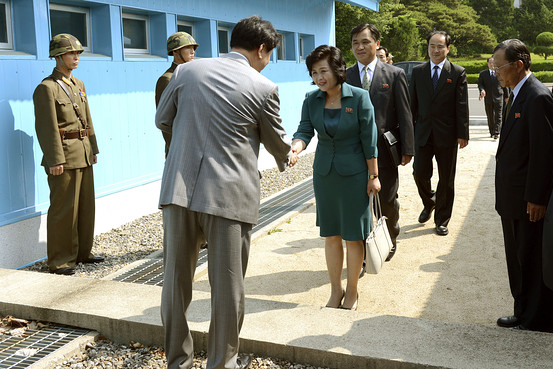
Another thaw in tense inter-Korea relations is developing, as North Korean reps crossed by foot the Military Demarcation Line (in the DMZ) on January 9 at the Panmunjom, Korea, on the way to talks with South Korean counterparts for sending NK athletes to the PyeongChang Winter Olympics.
More significantly, both sides also agreed to resume talks on military matters, in addition to re-opening of military hotline few days ago, that may usher in much-needed reduction of tensions in the peninsula.
September 22, 2014
The Controversy Over North Korean Flag at the Asian Games in South Korea
North Korea has sent its national team to Incheon, South Korea to participate in the 17th Asian Games.
South Korea is the host to this year’s event, but due to its domestic security laws regarding North Korea, controversies arose already. First, South Korean government has forbidden raising of the flags of participating nations of the games in order to singularly forbid North Korean flag from being seen outside the games’ official site – which is unprecedented measure and may go against the policies of the games. North Korean players may hoist their flag in the players’ housing area, but if South Koreans displayed the North Korean flag outside the site, they will be prosecuted under the draconian National Security Law. Second, North Korean journalists who accompanied the team were unable to send reports home because South Korean authorities block North Korean Internet sites.
With these residues of inter-Korea confrontation aside, Koreans will likely cheer both teams, and hopefully conciliatory mood will prevail and help towards warming of inter-Korea relations.
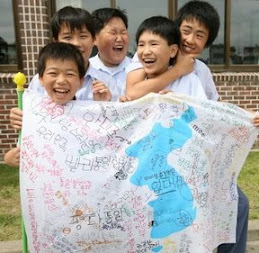
In another incident, FIFA authorities banned the displaying of "One Korea" flag by the spectators at the U20 Women's World Cup games, despite the fact that the flag that contains the image of the Korean Peninsula, symbolizing the yearning for Korean reunification, has been displayed widely at international sports events involving both Korean teams, including the Olympics, and at official inter-Korea meetings and functions. FIFA even sanctioned the North Korean soccer federation regarding the display of the flag, even though Korean Canadian and Korean American fans displayed the flag at the games independently.
South Korea is the host to this year’s event, but due to its domestic security laws regarding North Korea, controversies arose already. First, South Korean government has forbidden raising of the flags of participating nations of the games in order to singularly forbid North Korean flag from being seen outside the games’ official site – which is unprecedented measure and may go against the policies of the games. North Korean players may hoist their flag in the players’ housing area, but if South Koreans displayed the North Korean flag outside the site, they will be prosecuted under the draconian National Security Law. Second, North Korean journalists who accompanied the team were unable to send reports home because South Korean authorities block North Korean Internet sites.
With these residues of inter-Korea confrontation aside, Koreans will likely cheer both teams, and hopefully conciliatory mood will prevail and help towards warming of inter-Korea relations.
In another incident, FIFA authorities banned the displaying of "One Korea" flag by the spectators at the U20 Women's World Cup games, despite the fact that the flag that contains the image of the Korean Peninsula, symbolizing the yearning for Korean reunification, has been displayed widely at international sports events involving both Korean teams, including the Olympics, and at official inter-Korea meetings and functions. FIFA even sanctioned the North Korean soccer federation regarding the display of the flag, even though Korean Canadian and Korean American fans displayed the flag at the games independently.
September 24, 2013
Ups and Downs of Inter-Korean Relations
The Kaesong industrial park, which houses factories operated by South Korean companies with North Korean workers, has opened again after it was shut down for more than five months. But the promised reunion of separated families on Chuseok (Korean Thanksgiving) failed to materialize, indicative of the still fragile nature of inter-Korean relations.
June 10, 2013
Inter-Korea Dialog To Resume
After several years of acute animosity, the two sides of Korea will give a try at dialog, again. The two sides have agreed to hold a ministerial meeting on June 12 to discuss ways to reboot the inter-Korea economic ventures (Kaesung factory complex and Mout Keumgang tourism) and resume inter-Korea civilian exchanges. Hopefully the dialog this time around can give a fresh re-start on promised inter-Korea reconciliation and exchanges geared to promote lasting peace and cooperation in the Korean Peninsula. [The photo shows representatives of the two sides meeting for a preparatory meeting at Panmunjeom.]
[Follow-Up] Was it too good to be true? The ministerial meeting has failed to materialize as the two sides disagreed on who would head each side's delegation. This may be symptomatic of the up-and-down history of inter-Korea dialog.
January 2, 2012
Korea Enters 2012
The Korean Peninsula enters 2012 with both sides of Korea in flux. North Korea, with a recent transition of power, will be celebrating the 100th birthday of its founding leader Kim Il Sung in April. South Korea will be holding crucial elections in 2012 -- parliamentary elections in April and presidential election in December, with opposition forces eyeing for a transfer of power. China, Russia, and the US will be holding presidential elections or transfer of power as well.
With these expected changes and infusion of new players, an opportune moment may come in 2012 for a renewed and refreshed start of the peace process in the Korean Peninsula, with amending of relations between the two sides of Korea and a resolution of security issues. Let's hope for the best in 2012.
[Photo by AP: Sun rises in Pyongyang. With the AP now operating a bureau in Pyongyang, news stories and photos abound.]
December 21, 2011
North Korea After Kim Jong Il
Wild speculations and conjectures abound in the international circles in the aftermath of the death of Chairman Kim Jong Il of North Korea, whereas the transition of power to Kim Jong Un seems to be playing out without any incident. During upcoming uncertainties of the situation, all parties concerned should support a development conducive to fostering peace and reconciliation in the Korean Peninsula.
See alternative analyses: Korea Policy Institute article, interview on Democracy Now!
June 7, 2011
Inter-Korea Relations Hit Rock Bottom
Inter-Korea relations, once thriving and promising to bring the two sides of Korea closer toward reconciliation and some form of integration, has hit rock bottom, with return to mutual animosities of the Cold War era. Many avenues of inter-Korea contact and exchange set up during the two previous administrations of South Korea, in agreement with North Korea, have all but disappeared, with the joint economic venture in Kaesung being the sole remnant. North Korea even took over the operations of the Geumgang Mountain Resort area from Hyundai group and is trying to attract Chinese tourists. Border has been closed, cultural exchanges have stopped. South Korean authorities banned any food aid to North Korea and is considering prosecuting a South Korean NGO for sending food aid to North Korea.Recently, North Korea has announced that it will sever all contacts with South Korea and revealed a secret inter-governmental meeting between Pyongyang and Seoul, which contradicts the Lee Myung-bak government's public stance of no dialogue with North Korea. Both sides are emphasizing military readiness.
All these developments have blown away many accomplishments in inter-Korea relations of the last decade. To ensure peace and stability in the penindula, both sides will need to start from scratch again and build trust and confidence gradually.
March 29, 2011
Possible Volcanic Eruption Brings the Two Sides of Korea Together
Will a prospect for natural disaster bring the two sides of Korea closer? That may be the case as a rare inter-Korean meeting took place upon the aftermath of the earthquake/tsunami in Japan that focused on the possibility of volcanic eruption on Mt. Baekdu, a dormant volcano in North Korea-China border considered as sacred by the Koreans. More meetings and possible joint study is in the works, perhaps this can lead to wider inter-Korea dialogue aimed at reducing tensions. January 20, 2011
A Call for Peaceful Settlement in Korea
A Call for All Concerned Parties to Work for Peaceful Settlement in the Korean PeninsulaA Statement from NAKA (National Association of Korean Americans), Washington, DC, January 20, 2011
A precarious security situation in the Korean Peninsula continues as the tense military standoff between the two sides of Korea has not abated since the Yeonpyeong Island artillery incident. After the incident, South Korea went on a near-war mode as it revived civilian air raid drills (regularly-occuring drills that were cancelled during the past decade when inter-Korea relations were warmer), held live-fire artillery exercises in the disputed sea border area despite explicit warnings from North Korea, and engaged in massive joint naval military exercises with the U.S. as a show of force.
South Korea went further by talking with Japan on potential military cooperations, including a possibility of Japanese troops on the Korean soil, despite fierce opposition from Koreans weary with memories of historical Japanese military intrusions on Korea. China and Russia expressed their concerns on the U.S.'s massive show of force in the Northeast Asia and announced their own joint military exercises in the region, further escalating the situation and raising fears of renewed multi-nation arms race in the region.
Despite escalating tensions and war hysteria, both sides have gestured a need for a peaceful option, realizing unchecked escalation of military tensions would only lead to catastrophic war. North Korea opposed verbally at South Korea-U.S. maneuvers, but it did not retaliate further militarily, and called for unconditional talks with South Korea. South Korea, in a reversal, raised a possibility of the support of the revival of the six-nation talks aimed at North Korea's nuclear disarmament. Washington and Beijing, emphasizing cooperation (despite mutual distrust and competition) during the U.S.-China Summit, have called for improved inter-Korean relations and measures that would allow an early resumption of six-nation talks. A high-level inter-Korea military talks may materialize soon.
All these point to a negotiated settlement as the only viable option towards peace settlement in the Korean Peninsula -- all concerned parties need to work on it vigorously in 2011.
Subscribe to:
Posts (Atom)