Showing posts with label History. Show all posts

September 2, 2020

August 15: Korea's Liberation?


August 15, 2020 marks the 75th anniversary of Korea’s liberation from the Japanese colonial rule, yet it was not true independence as Korea was denied independent, self-government (as promised by the Allies during the wartime summits, and suggested on the US postage stamp shown above), but rather was suddenly divided arbitrarily in half without Koreans’ knowledge.
As the Pacific War of the WW2 was nearing its end, overseas Korean independence fighters and activists — of all political persuasions — were preparing to join their compatriots in Korea to build a new post-colonial nation. Fearing potential reprisals on its citizens, the Japanese colonial authorities even asked prominent Korean socialist leader to form an interim authority to oversee peaceful transfer of power to the Koreans.
But all these changed overnight because the US policymakers had a different design on Korea, based on US national interest and not in regard to the wishes of the Koreans. Rather than respecting Korea’s rightful quick transition to self-government upon liberation, the US wanted to establish its own sphere of influence in Korea (replacing Japan’s influence) in preparation for its own postwar planning for Asia. With the Soviet entry in the Pacific War and its quick defeat of the Japanese Army in Manchuria, it was logistically impossible for US forces to reach Korea before the Soviet forces to gain local control and influence.
Hence came an impromptu decision by Washington more akin to traditional colonial land grab (when colonial powers drew arbitrary lines on the map for areas of control) and political expediency rather than the immediate and stated military objective of accepting Japanese surrender in Korea. The US abruptly proposed on August 10, 1945 to divide Korea into two occupation zones (one Soviet and another US), for which the Soviets agreed without objection in deference to wartime cooperation. Therefore, the US got to gain a foothold in Korea and at least control a half of Korea, even though its troops were no way near Korea.
The euphoria of Korea’s liberation on August 15, 1945 turned into confusion, chaos and turmoil, as on one hand, Koreans were organizing local committees to peacefully disarm Japanese colonial forces and moving towards building Korean self-government, but on the other hand, the US forces arrived in Korea on September 8 (more than 3 weeks after Korea’s liberation), shot at welcoming Koreans, took over Japanese colonial government and military compounds, raised the US flag and not the Korean flag. So much could have been achieved towards Korean self-government in that three vital weeks. However, the US went on to disband and outlaw all independent-minded, pro-self government Korean entities and activities, and instead established a US military government in its zone, rehired colonial collaborators in the administration, and brought back Korean members of the dreaded Japanese colonial police force to harass the discontented and rebellious populace. Suddenly, the US forces were acting like new colonial overlords instead of liberators and guarantors of Korean independence.
Instead of fostering quick Korean self-government, the stern US military government rule created a toxic environment of political violence and turmoil (assassinations of Korean political leaders and wanton massacres of those deemed to be leftists). Although Korean governments, albeit two separate and competing ones, were formed in 1948 (eerily reflecting the two separate occupation zones in 1945), the policies and impact of the US military government in Korea, more so than the dynamics of the Cold War or internal Korean political strifes, laid the seeds of turmoil, discontent and volatility that eventually led to the Korean War and the continuing division of Korea, 75 years and counting.

July 29, 2020

From Korean War Armistice to Peace Settlement


Today marks the 67th anniversary of the signing of the Korean War Armistice Agreement, and yet we still do not have the “final political settlement” inscribed in the agreement. So, technically the Korean War has not officially ended, lacking a peace treaty that will replace the armistice and the ensuing uneasy truce.
Political/diplomatic dynamics have drastically changed in many ways since 1953, with the end of the Cold War for example, but the logical players that need to initially seek the peace settlement in Korea are still the nations behind the signatories of the armistice: the United Nations Command (the US), the Korean People’s Army (North Korea), and the Chinese People’s Volunteer Army (China).
South Korea did not sign the armistice in protest at the time (but did it regardless by being a part of the UN Command, and under the US command), but made several subsequent peace agreements with North Korea and is committed to inter-Korean rapprochement. The US and China normalized relations in the 70s. China (and Russia) normalized relations and made peace with South Korea. Both sides of Korea have become members of the UN and the UN has distanced itself from the UN Command in Korea, making it defunct in reality and making the UN incapable of being an arbiter in the resolution of the “Korea question.” The only remaining foreign troops in Korea are the US troops. And the only relation that has not changed after all these years is between the US and North Korea.
The talks between Washington and Pyongyang have again stalled, but they need to be resumed in light of the continuing uncertainty and volatility created by the absence of a peace treaty ending the Korean War. It is about time to put an official closure to the Korean War and chart a new path towards a meaningful peace settlement in the Korean Peninsula.

July 1, 2019

Trump's DMZ Crossing: Just a Photo-op or Opportunity for Progress?


Photo 1: On June 30, 2019, Trump crosses the raised concrete strip representing the Military Demarcation Line (MDL) that divides Korea at Panmunjum (the Joint Security Area in the DMZ/Demilitarized Zone), becoming the first sitting US president to step foot on North Korea.

Photo 2: Kim Jong-un crosses the same line into South Korea (accompanied by South Korea's Moon Jae-in), becoming the first North Korean leader to do so, in April 2018.

Photo 3: South Korean college student Im Soo-kyung (who went to North Korea to participate in the World Youth Festival) crosses the line, at the same location, into South Korea in 1989, becoming the first Korean civilian to willfully cross that line (and not by accident, defection or espionage) since the Korean War ended in an armistice and the creation of the MDL/DMZ in 1953.

Symbolism matters in the DMZ, like the Berlin Wall. That concrete line in the DMZ, a highly recognizable -- and painful to all Koreans -- symbol of prolonged Korean division and the last vestige of the Cold War, is now casually crossed over -- by government/military officials and civilians on inter-Korean meetings or exchanges.

And history was made this past Sunday as Trump crossed the line, symbolically as a "peacemaker" (whatever his motivation may have been) in a business suit and not wearing the usual military attire that US presidents had done when visiting the southern side of the DMZ in the past. [Trump's overall antics aside, his unprecedented summits with Kim and this DMZ crossing showed a way besides the business-as-usual approach.]

But that casual crossing has not been the case always. In 1989, Im Soo-kyung (accompanied by Father Moon Kyu-hyun) risked long imprisonment in South Korea for crossing that line (she received five-year sentence for violating South Korea's draconian and archaic National Security Law), in a brave and unprecedented action to help bring about a breakthrough for peace and reunification of Korea.
With persistent efforts and sacrifices of many civilian activists like Im, the once-impenetrable wall dividing Korea began to crack and led to a series of inter-Korean rapprochement and cooperation towards negotiated settlement for peace in Korea.

Now, the US and North Korea must transcend historical hostilities and animosities (and skepticism of cynics) and translate this historical moment into real progress towards negotiating a lasting peace settlement in the Korean Peninsula.

May 1, 2019

New Documentary: Korea -- The Never-Ending War


This is the most comprehensive and insightful film documentary on the Korean War, covering its origins and its aftermath, with focus not only on the historical and geopolitical perspectives, but on its impact on ordinary civilians (refugees, separated families, the No Gun Ri Incident of massacre of civilians by US soldiers), and the legacy of the “unending war” on current tensions in the peninsula, including the standoff over North Korea’s nuclear program.

February 15, 2019

[Obituary] Former "Comfort Woman" and Human Rights Activist Kim Bok-dong


Kim Bok-dong was born in 1926 in Yangsan, South Gyeongsang Province. After completing the fourth grade of elementary school, she helped out with household chores until the age of 15. Her mother had told her stay close to home because “the times were strange.”

One day in 1941 – she can’t remember if it was the spring or the fall – Japanese people in yellow uniforms without rank badges came to her house, accompanied by her village leader and another official. Kim was told she needed to work for three years at a factory making army uniforms – and if she didn’t go, her family would be kicked out of their house and their property seized.

Figuring that it wouldn’t kill her to work at a factory, Kim told her mother she would go. At the age of 15, she was taken to Taiwan and then on to a Japanese military unit based in China’s Guangdong Province. How different her life would have been if she hadn’t gone with the Japanese back in 1941!
READ MORE

December 9, 2016

The People Have Spoken


Koreans in South Korea have a long history of massive street protests that resulted in changes of governments. The April Student Revolution of 1960 led to the downfall of the Syngman Rhee dictatorship. The Bu-Ma Mass Protests of 1979 triggered a series of events that led to the end of the dictator Park Chung-hee's repressive regime. The June Democratic Uprising of 1987 brought democratic political reforms, including direct presidential elections.  Now, massive candlelight protests of Winter 2016, which was carried out peacefully with remarkable order, have prompted the impeachment of Park Geun-hye. 

Amidst popular outcry, the Park dynasty has come to an end. Park Chung-hee, a former officer in the Japanese Imperial Army who went after Korean independence fighters, made himself a president after staging a coup d'état in 1961, ruling with iron fist while suppressing popular dissent with acute brutality. Park's seemingly-endless reign ended in 1979 when his own Korean CIA chief, fearful of massive bloodshed of protesting people, assassinated his boss.  Park Geun-hye, the daughter of Park Chung-hee, was elected to presidency in 2012, under some suspicions of voting fraud and irregularities of government interference. Yet, the Park Geun-hye's demise was her own doing, as the corruption and cronyism surrounding her inner circles finally caught up with her. It can be said then that both the father and the daughter were removed from the president's office, in large part, by the popular will and action.

This is not the first time that candlelight protests and impeachment played out in conjunction in South Korea. Former president Roh Moo-hyun was also impeached in 2004, on a minor charge of electioneering that was amplified by the conservative opposition party legislators based on political motivation. During that time, candlelight protests called FOR THE RESCINDMENT of the impeachment and gave support to Roh.  In the end, the Constitutional Court overturned the impeachment and Roh returned to power.

Though the impeachment of Park Geun-hye will not be finalized until the decision of the Constitutional Court is made in coming months, the impeachment decision will likely hold due to the extent and gravity of the charges. Moreover, currently only 3% of South Koreans support Park Geun-hye and many are beginning to see the fallacies of her failed policies, such as the revision of history textbooks, agreement with Japan on the "comfort women" issue, agreement with the U.S. to place the THAAD anti-missile defense system, and the neglect and incompetent handling of the Sewol ferry disaster. The people have spoken -- coming out to the streets in millions, in six consecutive weekends.  Now, the people await the transition of power to a new government.

April 19, 2016

Filmmaker Dai Sil Kim-Gibson's New Documentary on North Korea


“People are the Sky” director on documenting meanings of home, family

In the documentary “People are the Sky”, filmmaker and writer Dai Sil Kim-Gibson returns to her birthplace in North Korea after the death of her Iowa-born husband Don. Kim-Gibson, with the goal of discovering what home truly means, finds a country where people live in peace and harmony. READ MORE

January 4, 2016

"Japan and South Korea: A New Beginning?"


By John Feffer


October 15, 2015

South Korea To Reinstate State-Issued Textbooks on Korean History


Below is a dated New York Times editorial, but it is still pertinent in light of the recent South Korean government's decision, despite wide opposition from citizens and academia, to reinstate state-issued textbooks on Korean history, that will attempt to whitewash the true nature of colonial period's pro-Japanese collaborators and post-liberation dictatorships. The last time these textbooks were state-issued was during the Park Chung Hee (father of the current South Korean president Park Geun-hye) dictatorship.


[The New York Times, Jan. 13, 2014,
 http://www.nytimes.com/2014/01/14/opinion/politicians-and-textbooks.html?_r=1]

Both Prime Minister Shinzo Abe of Japan and President Park Geun-hye of South Korea are pushing to have high school history textbooks in their countries rewritten to reflect their political views.
Mr. Abe has instructed the Education Ministry to approve only textbooks that promote patriotism. He is primarily concerned about the World War II era, and wants to shift the focus away from disgraceful chapters in that history. For example, he wants the Korean “comfort women” issue taken out of textbooks, and he wants to downplay the mass killings committed by Japanese troops in Nanking. His critics say he is trying to foster dangerous nationalism by sanitizing Japan’s wartime aggression.

Ms. Park is concerned about the portrayal of Japanese colonialism and the postcolonial South Korean dictatorships in history books. She wants to downplay Korean collaboration with the Japanese colonial authorities and last summer pushed the South Korean Education Ministry to approve a new textbook that says those who worked with the Japanese did so under coercion. (A majority of professionals and elite civil servants today come from families that worked with the Japanese colonizers.) Academics, trade unions and teachers have accused Ms. Park of distorting history.
Mr. Abe and Ms. Park both have personal family histories that make them sensitive to the war and collaboration. After Japan’s defeat in the war, the Allied powers arrested Mr. Abe’s grandfather, Nobusuke Kishi, as a suspected class A war criminal. Ms. Park’s father, Park Chung-hee, was an Imperial Japanese Army officer during the colonial era and South Korea’s military dictator from 1962 to 1979. In both countries, these dangerous efforts to revise textbooks threaten to thwart the lessons of history.

[See also related article from South Korea:
 http://english.hani.co.kr/arti/english_edition/e_national/712608.html ]

May 15, 2015

Korean Atomic Bomb Victims


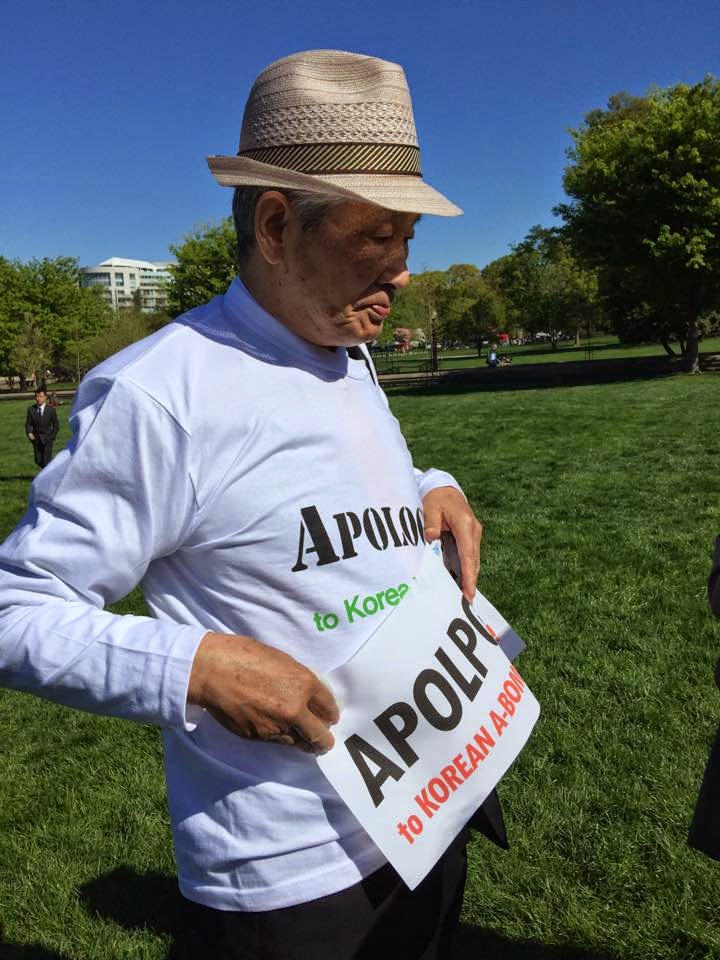
    Not many know that more than one seventh of WW II atomic bomb victims were Korean colonial subjects, most of whom were forced workers in Japanese military factories during the war. Korean "hibakusha" (atomic bombing survivor) were the forgotten people -- not compensated by the Japanese government when Japanese A-bomb victims were compensated, and neglected by the Korean government, as they were not included in the reparations that Japan gave to South Korea when the two countries normalized relations.  They are forgotten victims of colonialism and war like the military sex slaves ("comfort women"). 

July 9, 2014

Scenes of Daily Life in Korea from the 1900s


See more rare photos of scenes of daily life in Korea, during the early period of Japanese colonial rule, taken by a Japanese photographer. Some Korean commentators say that Japanese colonialism helped bring about modernization and industrialization to Korea, but that is no excuse for the brutal colonial occupation and subsequent division of Korea due to foreign interventions.

February 10, 2014

"The Attorney": The South Korean Film Portrays South Korean Politics


For those unfamiliar with South Korean history and politics, this movie, now playing at theaters in major North American cities with English subtitles (opened Feb.7), may seem like an average-lawyer-turned-activist-fighting-for-justice film. But the lawyer portrayed in this film is no ordinary person -- he is former President Roh Moo-hyun of South Korea.

The life/career-changing turn of events depicted in the film shows Roh's transformation from an ordinarily lawyer to a lawyer-activist devoted to defending cases related to human rights, social justice and fairness, which led him to the front of the pro-democracy civil movement in South Korea that ultimately brought down the military dictatorship, and all the way to the Blue House, the presidential office.

The film also highlights the pervasive and underlying obsession in the South Korean society with "national security." Due to harsh and polarized memories of the Korean War and the division of Korea, successive dictatorships and authorities in power in South Korea deemed convenient and easy to falsely label and prosecute all kinds of legitimate opposition and dissent as violations of South Korea's draconian National Security Law, in which, most times, legitimate protests and expressions are labelled as pro-North Korea and aiding North Korea and thereby requiring harsh and no-questions-asked prosecutions and punishments. In most of these cases, torture was used to extract false confessions that legitimized fabricated or exaggerated charges. These cases "surfaced" from time to time in order to quell down domestic dissent or to overshadow government's crisis or ineptitude.  Despite attempts to amend the National Security Law, it still stands and is applied even during democratic governments.

This surprising blockbuster, the first film directed by Yang Woo-suk, is currently on the sixth place on all-time attendance numbers in South Korea, which seems to resonate with the South Korean populace -- the older generations who have experienced this tumultuous period, as well as the younger generation born after this period. This movie starts out with comic moments, but turns into a serious court drama that depicts the dark era of political repression and human rights abuse in South Korea, as well as optimism for change and progress. This film is highly recommended to non-Koreans as it not only depicts the subtleties of South Korean politics but also tells of universal yearnings for justice and fairness.

December 16, 2011

1000th Continuous Wednesday Protest on "Comfort Women" Issue

Dec. 14, 2011 marked the 1000th "Wednesday Protest" on behalf of the Korean "Comfort Women" victims -- the continuous protest every Wednesday, rain or shine, for the past 19 years in front of the Japanese embassy in Seoul, Korea. The few surviving and aging victims and their support organization (The Korean Council for the Women Drafted for Sexual Slavery by Japan) have been demanding sincere acknowledgement and apology from the Japanese government on this issue, yet no representative of the Japanese embassy has ever come out of its building over these years to acknowledge the protesters.

The silence of the Japanese authorities on this issue will not deter the protesters though, who have vowed to continue on until they pass away, if necessary. As the Japanese and South Korean governments aim to work toward a "future-oriented" relationship, the first task is to acknowledge the past, especially those painful ones that have not been adequately addressed or redressed, like the wartime "comfort women" sexual slavery issue. Solidarity protests occurred worldwide, including in front of the Japanese embassy in Washington, DC.
Photos are scenes from the protest in Seoul, the bottom photo shows former "comfort women" survivors at the "peace memorial" statue that was erected across from the Japanese embassy, with the likeness of young Korean girl who were forced to serve as sex slave for the Japanese military.

August 12, 2011

August 15th: Korea's Liberation Day

August 15th is the Liberation Day in Korea, when Koreans celebrate its independence from Japanese colonialism. But since the Allied powers (mainly the US and USSR) had strong hands in liberating Korea, the end result was the "temporary" division that led to an eventual war, prolonged division and yet-unresolved tension in Korea. One of the last surviving members of Korean independence fighters said that "the true liberation of Korea would happen when the two sides of Korea reunite."

To many, the real history of Korean division is shrouded in Cold War-era mentality and narrative, especially amongst Americans whose government had been and are deeply involved with Korean affairs (for example, how many Americans know that Korea was under direct U.S. military government for three years after the "liberation"?) Some do understand it, as expressed keenly by an American expat teaching English in South Korea.


August 22, 2010

Centennial of Japan's Annexation of Korea

100 years ago on August 22, 1910, Japan forcefully annexed Korea -- setting in motion a tragic and volatile period for modern Korea that saw colonialism, liberation, division, war and continuing division. Though there were Korean collaborators to Japanese colonial rule, there were also others who took arms to deter Japanese aggression, such as the Righteous Army pictured above, and other groups in Manchuria and Northeast China.

August 3, 2009

Former "Comfort Women" Demand Japan's Apology

Kil Won-ok (age 81) is former "comfort woman"-turned-activist calling for the Japanese government's formal apology for the sexual enslavement of girls and women (taken mostly from colonial Korea) during the World War II. She was only 13 years old when she was forcefully taken to the war fronts to "serve" Japanese soldiers. Battered and ashamed, she could not return to her home in northern Korea when the war ended and lived alone and poor in the south, keeping her silence until she joined a group advocating for the rights of former "comfort women."

She and representatives of the Korean Council for Women Drafted for Military Sexual Slavery by Japan came to the U.S. recently on the occasion of the second anniversary of the passing of the US House Resolution 121 that called for Japan's formal apology. Even with this passage and others in Canada and European assemblies, Japanese government is not coming forward with an apology -- in a stark contrast to postwar Germany's handling of the holocaust. The photo shows Ms. Kil during the "Wednesday Demonstration" in front of the Japanese embassy in Seoul, Korea. The women have staged the weekly demonstrations every Wednesday continuously for the past 17 years, yet not a single Japanese official has come out and acknowledged the women's presence.

April 11, 2009

Seoul Scenes of One Hundred Years Ago

Scenes of Seoul in the Namdaemun (The Great South Gate) area about one hundred years ago show traditional life not yet impacted much by modernization and urbanization.

March 30, 2009

A Return of Right-Wing Terror in South Korea?

A civilian "Patriotic Mobile Force" [photo and article in Korean from OhMyNews] was created recently by ultra-conservatives in South Korea to "physically repel leftist protesters." What is disturbing is that the founders of this group, mostly ex-soldiers, are non-apologetic to the right-wing terror that was rampant in the post-liberation period of 1945 to 1950 when extreme violence and political assassinations were used to intimidate leftist and even moderate political forces. Presence of this group as counter-demonstrators in public protests will likely inflame the situation that is already tense due to stepped-up police crack-down of protesters.

March 11, 2009

"Atomic bomb survivors in South Korea still feel the wounds"

The Los Angeles Times carried an in-depth look at Korean atomic bomb survivors ("hibakusha" in Japanese) who are seeking compensation from the Japanese government. Unknown mostly to the world, 40,000 Korean civilians (one-quarter of the total victims) perished in the Hiroshima and Nagasaki atomic bombings, along with the Japanese. Most of the Koreans were forced laborers sent to Japan by colonial authorities to work in military factories and mines. In the case of the southern Korean town of Hapchun, highlighted in the article (the photo from The L.A. Times shows a survivor with pictures of Hiroshima bombing), 70 % of its population was relocated to Japan, resulting in a disproportionate number of atomic bomb victims, who returned home only to face poverty, prejudice, government neglect and loneliness.

March 1, 2009

90th Anniversary of March 1st Movement for Korean Independence

Today is the 90th anniversary of the March 1st Movement for Korean Independence, a nationwide demonstrations in 1919 that peacefully challenged the repressive Japanese colonial rule over Korea. The Japanese authorities' harsh crackdown resulted in over 7,500 Korean lives killed by the Japanese police. The photo from the Hankyoreh shows the anniversary celebrants reenacting the Manse chants ("long live Korean independence") in Seoul. The movement was inspired by U.S. President Woodrow Wilson's principle of "self-determination" right in his "Fourteen Points" speech, but the major powers ignored the Korean plea for independence and did not challenge the Japanese expansionism in Asia until two decades later. Koreans began to organize themselves to regain independence, in the Provisional Government in Shanghai and military operations in Manchuria.