Showing posts with label Korea-Japan Relations. Show all posts

February 15, 2019

[Obituary] Former "Comfort Woman" and Human Rights Activist Kim Bok-dong


Kim Bok-dong was born in 1926 in Yangsan, South Gyeongsang Province. After completing the fourth grade of elementary school, she helped out with household chores until the age of 15. Her mother had told her stay close to home because “the times were strange.”

One day in 1941 – she can’t remember if it was the spring or the fall – Japanese people in yellow uniforms without rank badges came to her house, accompanied by her village leader and another official. Kim was told she needed to work for three years at a factory making army uniforms – and if she didn’t go, her family would be kicked out of their house and their property seized.

Figuring that it wouldn’t kill her to work at a factory, Kim told her mother she would go. At the age of 15, she was taken to Taiwan and then on to a Japanese military unit based in China’s Guangdong Province. How different her life would have been if she hadn’t gone with the Japanese back in 1941!
READ MORE

March 11, 2016

Protest on the Korea-Japan "Comfort Women" Announcement


The 1221st "Wednesday Protest" took place in front of the Japanese embassy (special protest in Washington, DC) with survivor and delegation from South Korea on the "comfort women"/military sex slavery issue. The following is the statement from the rally.


We Denounce the Korea-Japan Announcement on the “Comfort Women” Issue

The military sexual slavery (“comfort women”) system perpetuated by the Japanese military during the World War II in Asia was a war crime committed by the wartime Japanese government, and it is clearly sex crime and human rights violation against women (mostly Korean), including minors aged 13 to 16.

To this day, the Japanese government has made statements on this issue which attempt to whitewash its own responsibility and the coercive nature of the abusive system. The recent Korea-Japan joint announcement on this issue does not drift afar from this.

The Japanese government needs to admit the coercive nature of the “comfort women” mobilization as historical accuracy and provide its legal responsibility and direct reparations – only then will there be sincerity in its apology and lead to the true recovery of honor and dignity of the surviving victims.

We also denounce the diplomatic folly by the Park Geun-hye government of South Korea for reaching this agreement without consultation with the survivors, that does not include official apology from the Japanese government, that yielded to the Japanese pressure on possibly removing the statue (which depicts a victim) across from the Japanese Embassy in Seoul, and agreeing to “irreversible” clause that will prevent future settlements on this issue. Many Korean citizens have voiced strong anger and the survivors have proclaimed this agreement as null and void.

In solidarity with the continuing effort of the survivors on this issue, we will continue to push for full and sincere apology and legal responsibility from the Japanese government.

March 10, 2016
Participants of the 1221st Wednesday Protest, in front of Japanese Embassy in the USA

Contact: nabiusadc@gmail.com

January 4, 2016

"Japan and South Korea: A New Beginning?"


By John Feffer


December 29, 2015

A Statement by Korean NGO on Korea-Japan Agreement on the "Comfort Women" Issue


Here is a statement from the South Korean NGO working on the "comfort women" issue on the recent governmental agreement on the issue, citing the absence of legal responsibility by the Japanese government and the lack of Korean government's consultation with the survivors:
----------------

The Official Statement from the Korean Council for the Women Drafted for Military Sexual Slavery by Japan regarding the Agreement on the Military Sexual Slavery (“Comfort Women”) Issue during the Korea-Japan Ministerial Meeting

Today’s meeting between the foreign ministers of South Korea and Japan concluded with an agreement on the resolution for the military sexual slavery issue. The survivors of the “Comfort Women” system as well as the Korean citizens sincerely hoped for the rightful resolution on the issue through this meeting, on the year which marks the 70th anniversary of Korea’s independence.

The Agreement specified that: first, Japanese government feels its responsibilities for the military sexual slavery; second, Prime Minister Abe apologizes as the representative of the Japanese government; and third, the Korean government establishes a foundation where Japanese government provides the funding while the two governments collaboratively manage initiatives.

Although the Japanese government announced that it “feels [its] responsibilities,” the statement lacks the acknowledgment of the fact that the colonial government and its military had committed a systematic crime. The government had not just been simply involved but actively initiated the activities which were criminal and illegal. Also, the apology was not directly made by the Prime Minister himself as the official representative of the government but was read by a diplomatic representative, while it was unclear to whom he was actually apologizing. Hence it is hard to believe if it was a sincere apology.

In addition, the announcement specified that Korean government will be responsible for establishing the foundation, despite the fact that Japanese government must be actively involved in follow-up initiatives, including acknowledgement of its criminal responsibilities and legal reparations. It appears that Japan will pass the future responsibilities on to the government of the victims’ country after simply paying off the money. Also, it is notable that the Agreement did not specify anything on preventative initiatives such as truth seeking and history education.
The Korean government’s attitude towards this Agreement, which is vague and incomplete, is rather shocking. The government concurred that this Agreement represents a “final, irreversible” settlement of the issues, as long as the Japanese government is committed to the due diligence in the future. Meanwhile, the Korean government promised that it will seek a resolution for the matter of the Peace Monument in front of the Japanese Embassy in Seoul in order to maintain the dignity of the Embassy, and will limit its criticism against Japanese government internationally. This is a diplomatic humiliation.

The Korean government accepted the Japanese government’s absurd condition on the Agreement which demanded the removal of the Peace Monument. Moreover, the attitude of the former which declared that it will not even mention the military sexual slavery issue in the future is shameful and disappointing.

The Peace Monument cannot be a condition or means for any Agreement. It is a public property and a historic symbol representing the peaceful spirit of the Wednesday Demonstrations, which has been continued by the survivors and the citizens for over a thousand Wednesdays. The Korean government cannot mention anything about the removal or moving of the Monument. While the survivors and the civil society cannot accept the Agreement, the governments cannot push their own agenda. Such an act of arrogation only adds to the pain of the victims even more.
All these years, the survivors, supporting civil society organizations and citizens demanded that Japanese government acknowledge its national, legal responsibilities clearly and commit to due diligence in order to recover dignity and human rights of the survivors and prevent any such tragedy in the future. However, the Agreement today is only a diplomatic collusion which betrays the demands from all.

The military sexual slavery issue must be resolved to bring true friendship and peace between Korea and Japan while more survivors are still alive. However, this cannot be rushed while defying proper principle and common sense.

In 2012, the 12th Asia Solidarity Conference for the Resolution of the Military Sexual Slavery by Japan Issue adopted recommendations for the Japanese government to commit to its governmental, legal responsibilities. In order to make such a commitment actually happen, the Korean Council will continue to work tirelessly with the survivors and the domestic and international civil society.

28 December, 2015

The Korean Council for the Women Drafted for Military Sexual Slavery by Japan

May 15, 2015

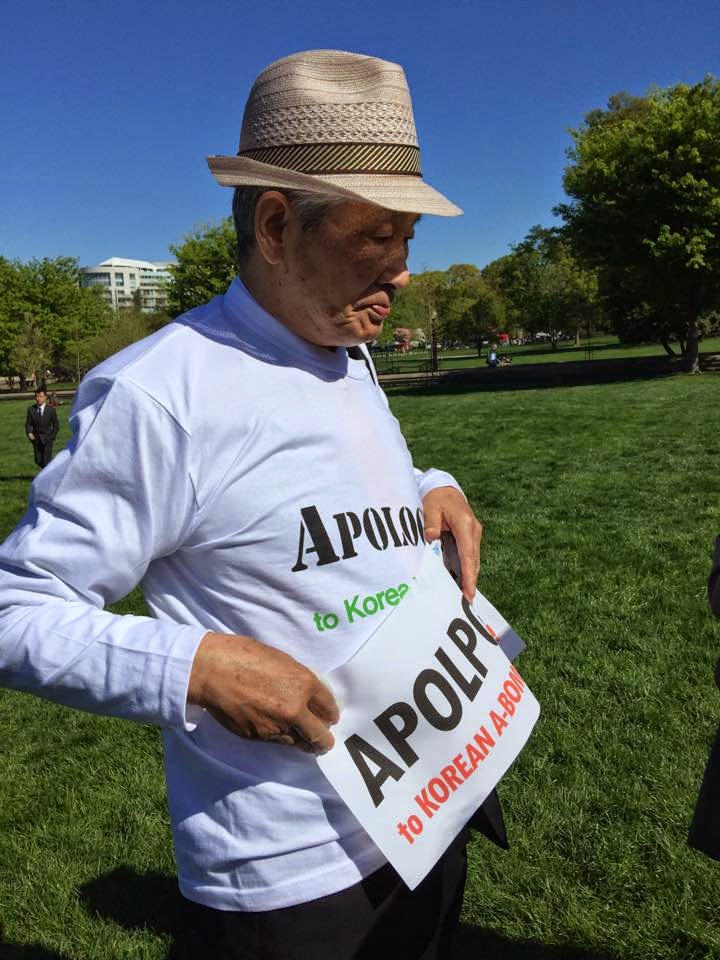
Korean Atomic Bomb Victims


    Not many know that more than one seventh of WW II atomic bomb victims were Korean colonial subjects, most of whom were forced workers in Japanese military factories during the war. Korean "hibakusha" (atomic bombing survivor) were the forgotten people -- not compensated by the Japanese government when Japanese A-bomb victims were compensated, and neglected by the Korean government, as they were not included in the reparations that Japan gave to South Korea when the two countries normalized relations.  They are forgotten victims of colonialism and war like the military sex slaves ("comfort women"). 

August 18, 2012

The Issue of "Comfort Women" (Enforced Sex Slaves) Persists

Sixty-seven years since Japan was defeated in the World War II, the lingering issues surrounding Japan's wartime crimes persist because Japan is not forthcoming in acknowledging its past actions during the war, known for brutal conquests and barbaric treatment of subjects in occupied territories. The military "comfort women" or enforced sex slaves issue stands out, because, despite the appeals of the aging survivors for Japan's acknowledgement and apology, Japanese authorities continue to downplay the issue by excluding the issue in its textbooks or implying that this was a voluntary prostitution (there were Japanese prostitutes in the system, but those recruited from colonial areas were recruited forceably or tricked into it with promise of factory jobs). Meanwhile, demonstrations in front of the Japanese embassy in Seoul, as well as in Washington, DC (above photo), continue on.

The issue is pertinent today as there are pockets of sexual assaults in war zones around the world, as well as human trafficking of sex slaves. The Korean "comfort women" survivors have raised this connection of the past and present and have started a fund-raising campaign to aid the present victims of military sex assaults in Africa.

December 16, 2011

1000th Continuous Wednesday Protest on "Comfort Women" Issue

Dec. 14, 2011 marked the 1000th "Wednesday Protest" on behalf of the Korean "Comfort Women" victims -- the continuous protest every Wednesday, rain or shine, for the past 19 years in front of the Japanese embassy in Seoul, Korea. The few surviving and aging victims and their support organization (The Korean Council for the Women Drafted for Sexual Slavery by Japan) have been demanding sincere acknowledgement and apology from the Japanese government on this issue, yet no representative of the Japanese embassy has ever come out of its building over these years to acknowledge the protesters.

The silence of the Japanese authorities on this issue will not deter the protesters though, who have vowed to continue on until they pass away, if necessary. As the Japanese and South Korean governments aim to work toward a "future-oriented" relationship, the first task is to acknowledge the past, especially those painful ones that have not been adequately addressed or redressed, like the wartime "comfort women" sexual slavery issue. Solidarity protests occurred worldwide, including in front of the Japanese embassy in Washington, DC.
Photos are scenes from the protest in Seoul, the bottom photo shows former "comfort women" survivors at the "peace memorial" statue that was erected across from the Japanese embassy, with the likeness of young Korean girl who were forced to serve as sex slave for the Japanese military.

August 19, 2011

Protests Against Japan's Policies Amidst Korea's Liberation Day Celebrations

In solidarity with former Korean "comfort women" and supporters who have demonstrated in front of the Japanese embassy in Seoul on every Wednesday for the past ten years to demand the Japanese government's acknowledgement and apology of its role in the wartime military sex slave system, activists in the Washington, DC area demonstrated in front of the Japanese embassy in Washington on Wednesday, August 17, 2011.

The following is their statement:

This week, Koreans throughout the globe are commemorating the 66th anniversary of Korea’s Liberation Day (August 15, 1945) from the Japanese colonialism.

The reason why we have gathered in front of the Japanese Embassy today is to show our grave concerns on the Japanese government’s continuing refusal to acknowledge its wartime crimes such as the “comfort women” (military sex slave system) issue.

Unlike the German government, the Japanese government still refuses to come to terms with the ramifications of its wartime crimes, but instead pursues teachings of revisionist history through school textbooks that whitewash its wartime atrocities inflicted on civilians of Korea, China, and other Asian countries.

Moreover, the Japanese government has recently provoked confrontations with Korea with the Dokdo Island dispute, disregarding Korea’s historic and sovereign claim to the islands. Koreans painfully remember that one of the first steps taken by Japan in colonizing Korea was to incorporate the Dokdo Islands as its own territory, as a strategic stepping stone towards its territorial ambitions in Asia.

We demand that:
1. Japanese government fully acknowledge the wartime military sex slave system and apologize to its surviving victims;
2. Japanese government stop using school textbooks that distort wartime history;
3. Japanese government issue public apology regarding its wartime crimes and set up a compensation fund to surviving victims;
4. Japanese government stop disputing Korea’s sovereignty over the Dokdo Islands.

SaSaSe-Washington (Korean Americans for Peace)
Washington Special Committee on the Dokdo Islands

January 12, 2011

South Korea and Japan Talk of Military Cooperation

Something unthinkable is happenning -- South Korea and Japan are talking of closer military cooperation, starting with sharing of military intelligence, but which may lead to other forms of closer cooperation. There have been loose cooperations in the context with the U.S.-Japan-South Korea alliance in the region, but never a direct military cooperation between Tokyo and Seoul. The governments point this as a response to North Korean provocations, but South Korean citizens are outraged at a possibility that Japanese troops may again set foot on Korea [see above photo].

This is another step that will inadvertently contribute in escalating the tense situation in the Korean Peninsula, combined with the refusals on recent offers of dialog from Pyongyang.

November 17, 2010

Japan Agrees to Return Korean Royal Books

South Korea and Japan signed a treaty on Nov. 14 confirming the return of 1,205 Korean royal books taken during Japan’s colonial rule of Korea. (The photo shows Japan’s Prime Minister Naoto Kan, left, and Korean Pres. Lee Myung-bak looking at the books to be returned to Korea.)

In a related development, France has agreed to return on a permanent lease basis a collection of royal documents considered national treasures by South Korea and seized by the French navy in the 19th century, during attempts to forcibly open Korea to the West.

These are good developments as nations attempt to rectify and reconcile colonial wrongdoings, yet Japan has a long way to go towards historical reconciliation with Korea, as it needs to acknowledge war crimes committed during its imperial expansion, mainly on the "comfort women" (military sex slave) issue. Activists and former "comfort women" have been demonstrating in front of Japan's embassy in Seoul every Wednesday for the past twenty years, asking for acknowledgement and apology, yet not a single representative of Japan has acknowledged the protesters' presence.

August 22, 2010

Centennial of Japan's Annexation of Korea

100 years ago on August 22, 1910, Japan forcefully annexed Korea -- setting in motion a tragic and volatile period for modern Korea that saw colonialism, liberation, division, war and continuing division. Though there were Korean collaborators to Japanese colonial rule, there were also others who took arms to deter Japanese aggression, such as the Righteous Army pictured above, and other groups in Manchuria and Northeast China.

August 31, 2009

"Japan’s Democratic Party foreign policy platform prioritizes Korean peninsula"

[From the commentary in The Hankyoreh following the Japanese election that brought the opposition Democratic Party in power, with the leader Yukio Hatoyama (photo).]

Korea policy takes up a much larger portion of the foreign policy platform of the Democratic Party of Japan (DPJ) than of the Liberal Democratic Party (LDP).

Since its formation in 1955, the LDP had based its foreign policy upon exclusively dealing with U.S. affairs, but the DPJ’s position has placed a priority on foreign policy in Asia in order to denuclearize Northeast Asia, and the Korean peninsula in particular.

The DPJ’s platform calls for the creation of an East Asian community with the creation of a regional cooperative system in the Asia-Pacific predicated on establishing equal diplomacy with the U.S. As an East Asian community fundamentally involves a push for South Korea, China, North Korea and Japan to promote the denuclearization of East Asia, trust with surrounding nations is of utmost importance. In the long term, the DPJ also dreams of issuing a regional currency similar to the Euro.

The DPJ platform goes beyond opposing visits to the Yasukuni Shrine by the prime minister and other ministers, and calls for the creation of a new public memorial facility. This expresses the will to eliminate the source of friction between Japan and its neighbors during the administration of Prime Minister Koizumi Junichiro. Moreover, in the policy booklet that forms the basis of its manifesto, the party has revealed its position to establish a research bureau in the National Diet Library to study peace issues in order to put to rest post-war issues, including the issue of comfort women. This is something that was inconceivable during the former LDP administration.

When acting DPJ President Ozawa Ichiro was head of the LDP, he visited South Korea in 1999 and became the first minister-level Japanese figure to pray at the graves of independence activists such as Kim Ku, much to people’s great surprise. Ozawa’s image had been that of a rightist and a hawk who advocated that Japan become a “normal country,” but he is surprisingly becoming known as a “liberal” on issues of history.

August 3, 2009

Former "Comfort Women" Demand Japan's Apology

Kil Won-ok (age 81) is former "comfort woman"-turned-activist calling for the Japanese government's formal apology for the sexual enslavement of girls and women (taken mostly from colonial Korea) during the World War II. She was only 13 years old when she was forcefully taken to the war fronts to "serve" Japanese soldiers. Battered and ashamed, she could not return to her home in northern Korea when the war ended and lived alone and poor in the south, keeping her silence until she joined a group advocating for the rights of former "comfort women."

She and representatives of the Korean Council for Women Drafted for Military Sexual Slavery by Japan came to the U.S. recently on the occasion of the second anniversary of the passing of the US House Resolution 121 that called for Japan's formal apology. Even with this passage and others in Canada and European assemblies, Japanese government is not coming forward with an apology -- in a stark contrast to postwar Germany's handling of the holocaust. The photo shows Ms. Kil during the "Wednesday Demonstration" in front of the Japanese embassy in Seoul, Korea. The women have staged the weekly demonstrations every Wednesday continuously for the past 17 years, yet not a single Japanese official has come out and acknowledged the women's presence.

March 11, 2009

"Atomic bomb survivors in South Korea still feel the wounds"

The Los Angeles Times carried an in-depth look at Korean atomic bomb survivors ("hibakusha" in Japanese) who are seeking compensation from the Japanese government. Unknown mostly to the world, 40,000 Korean civilians (one-quarter of the total victims) perished in the Hiroshima and Nagasaki atomic bombings, along with the Japanese. Most of the Koreans were forced laborers sent to Japan by colonial authorities to work in military factories and mines. In the case of the southern Korean town of Hapchun, highlighted in the article (the photo from The L.A. Times shows a survivor with pictures of Hiroshima bombing), 70 % of its population was relocated to Japan, resulting in a disproportionate number of atomic bomb victims, who returned home only to face poverty, prejudice, government neglect and loneliness.

March 1, 2009

90th Anniversary of March 1st Movement for Korean Independence

Today is the 90th anniversary of the March 1st Movement for Korean Independence, a nationwide demonstrations in 1919 that peacefully challenged the repressive Japanese colonial rule over Korea. The Japanese authorities' harsh crackdown resulted in over 7,500 Korean lives killed by the Japanese police. The photo from the Hankyoreh shows the anniversary celebrants reenacting the Manse chants ("long live Korean independence") in Seoul. The movement was inspired by U.S. President Woodrow Wilson's principle of "self-determination" right in his "Fourteen Points" speech, but the major powers ignored the Korean plea for independence and did not challenge the Japanese expansionism in Asia until two decades later. Koreans began to organize themselves to regain independence, in the Provisional Government in Shanghai and military operations in Manchuria.

February 6, 2009

Japanese Soldiers Create Snow Sculpture of Namdaemun

In this interesting photo from the AP/Yonhap, Japan’s Self-Defense Force soldiers are putting the finishing touches on Korea’s historic gate of Namdaemun ("The Great South Gate," the original name is Soongraemun) made of snow in preparation for the 60th Sapporo Snow Festival in northern Japan. This seems like a welcome and friendly gesture in memory of the Korean cultural icon Namdaemun, which was destroyed by arson fire last year. And it is customary for famous building or people of previous year to be featured in the Sapporo snow festival.

But one wonders, are these young Japanese soldiers and their peers, getting exposure to full and truthful history of Japanese colonial and militaristic expansion in Korea and Asia, in light of continuing controversy over revisions of Japanese school textbooks that try to whitewash past wrongdoings of the Imperial Japan? Koreans still have vivid and painful memories of Japanese soldiers passing these gates to Seoul to forcefully annex Korea and institute a harsh colonial rule over Koreans for 36 years. With continuing controvery over the Japanese government's refusal to offer formal apology on the "comfort women" issue and the disputes between Korea and Japan on the Dokdo Islands and the international naming of the Sea of Japan (East Sea), the bad feelings of colonial legacy continue, waiting for more complete historical reconciliation.

September 18, 2008

DC APA Film Festival to Feature Films on Korean "Comfort Women"

The 9th annual DC APA (Asian Pacific American) Film Festival (Sept. 25 - Oct. 4) will feature two documentaries on surviving Korean "comfort women" -- those who were forced to provide sexual services to Japanese soldiers during the WW II, for whom Japan refuses to give official apology and compensation:

BEHIND FORGOTTEN EYES,

THE HOUSE OF SHARING

August 5, 2008

Escalation Over the Dokdo Islets

Korea (both sides) and Japan disagree on the name of the body of seawater between them: the East Sea ("Dong Hae") or the Sea of Japan. But it is the Dokdo Islets in this sea that has caused much tensions and raised emotions between Korea and Japan since the World War II, with both sides claiming territorial sovereignty over them.

Recent escalation started with the change in Japanese textbooks that challenged Korean claims and likened the islets, called Takeshima in Japan, as "disputed land," which resulted in a recall of South Korean ambassador from Japan, massive outcry in Korea, with some boycotting Japanese goods.

In another development, a proposed name change of the islets in the Libray of Congress classification system to Liancourts Rocks (named by the West after a French whaling ship that almost crashed on the rocks) was postponed by efforts by a Korean librarian in Canada.

Coincidentally, perhaps with some nudging by Japan, the U.S. Board on Geographic Names (BGN) suddenly changed its designation of the Dokdo islets in its web database from Korean sovereignty to "undesignated sovereignty." After protests and diplomatic lobbying by Koreans, President Bush ordered the reversal of the name change and reinstatement of the original designation.

The Dokdo Islets' territorial issue is a sensitive issue for Koreans since it touches on the painful legacy of the Japanese colonialism. Despite traditional Korean claims to the islets, Japan annexed the islets in 1905, when Korea was under Japan's forced protectorate and could not challenge the move diplomatically or militarily, in a precursor move to the annexation of whole Korean peninsula.

At the end of the WWII, the US forces took over the islets for bombing practice purposes, and eventually handed over to South Korea. Then-president Rhee Syngman, in part to deflect public attention or opposition, raised the nationalistic pitch and "Dokdo is Our Land" became a catch phrase in Korea. Since then, South Korea and Japan normalized relations and became amicable trading partner, but Korea has not yielded on the issue of Dokto to the Japanese pressure. As the photo of recent South Korean naval exercises near Dokdo shows, South Korea is determined to defend the islets militarily if necessary.

February 19, 2008

Korea-Japan Peace Tunnel?

Japanese lawmakers have proposed an underwater railway tunnel linking Japan to Korea. If this is meant to symbolize peaceful ties between Korea and Japan by overcoming historical animosities and the expansion of multilateral economic cooperation in Northeast Asia, Japan would need to make amends with North Korea by moving forward in its deadlocked normalization process. Without North Korea-Japan normalization, the prospects for uninterrupted raliway linking from Tokyo to London, using the revitalized inter-Korean railway, would be dim.

November 20, 2007

Will Japan Block US-NK Detente and Derail the 6 Party Talks?

Japan's new Prime Minister Yasuo Fukuda's recent meeting with President Bush was somewhat strained over Japan's insistence that North Korea not be taken off the US list of state sponsor of terrorism unless the issue over Japanese abductees to North Korea is resolved. Is Japan willing to derail the six party agreements on nuclear disarment and security in Northeast Asia due to this single issue?

Donald Kirk of the Asia Times Online has an interesting commentary: "The differences between the two were etched clearly as Fukuda and Bush sparred politely over the question of how to deal with North Korea. The problem is simple. Bush is anxious for a foreign policy 'success' that may be inscribed in his 'legacy' as president, and it looks as though detente on the Korean peninsula may be about the best he can hope for after a record of failure, disappointment and, on occasion, half-success in the middle east."