June 7, 2018
Korean Americans Call for Genuine Peace Ahead of Kim-Trump Summit
May 15, 2015
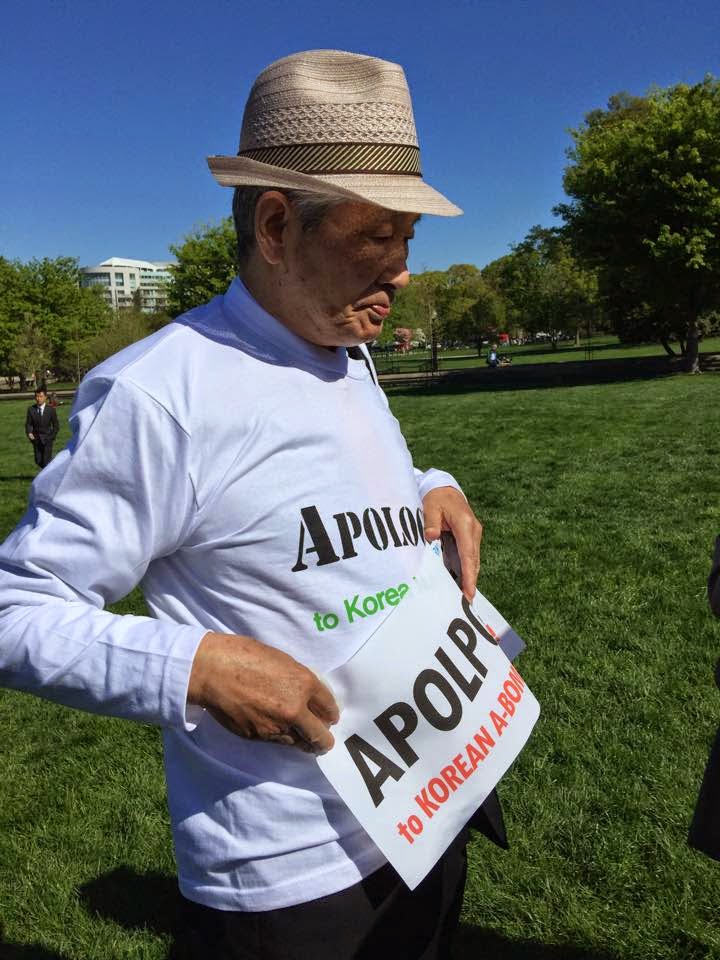
Korean Atomic Bomb Victims
October 28, 2009
Doing Business in North Korea
In a respite from preoccupation with the North Korean nuclear/security issue, U.S. media is beginning to take notice of other issues, such as joint ventures and business interactions in North Korea, that shed some light on changes occuring within North Korea.The CNN carried an interview with Hyun Jeong-eun, the chairwoman of South Korea's Hyundai Asan, which has pioneered inter-Korea joint ventures with investment of $272 million in North Korea, in projects like the Kaesong Industrial Park and tours to Mount Kumgang.
The Fortune magazine recently featured "The capitalist who loves North Korea," about Korean-American entrepreneur James Kim (photo, in front of his university in North Korea) who is fulfilling his dream of opening a Western-style university in North Korea that will offer classes similar to a MBA program.
October 17, 2009
"Tiger Spirit" -- A Documentary Film on Korean Reunification
Films on Korean reunification issues are scarce, as the news media is mainly preoccupied with the security issue and bypasses the underlying issues of the division and its impact on average Koreans. This new documentary film by a Korean-Canadian filmmaker Min Sook Lee, supported by the National Film Board of Canada, sheds some light on the latter. The following is a description of the film from the film site:
The psychic scar shared by millions of people, separated from their families during the Korean War in the 1950s, is symbolized by the Demilitarized Zone (DMZ) dividing communist North from capitalist South. Here, along this infamous border, award-winning filmmaker Min Sook Lee sets out on a revelatory, emotion-charged journey into Korea’s broken heart, exploring the rhetoric and realism of reunification through the extraordinary stories of ordinary people.
Tiger Spirit begins in the Korean foothills, where the filmmaker joins former TV videographer Lim Sun Nam in his obsessive quest to prove tigers still live in the DMZ’s swath of wilderness. A powerful symbol of resilience in Korean mythology, the tiger once roamed the peninsula but is thought extinct in the region. Lim believes finding the tiger will reconnect Koreans to their spirit and fuel the reunification train.
But a tiger’s stripes extend beyond its fur. Inspired by her desire to understand the country she left as a child when her family moved to Canada, Lee takes us deeper than symbols, asking the crucial question—how will the two Koreas be put back together?
We meet stoic elderly Koreans holding out for news of long lost relatives in the North. We encounter the fractured lives of younger defectors, including a woman who relives her harrowing escape story every day working as a tour guide at a war memorial site.
Crossing the DMZ into North Korea, we visit an inter-Korean economic project in Kaesong, the ancient capital. And we gain unprecedented access to state-sanctioned family reunions held at a high security “resort,” where we witness the Kim family’s heart-wrenching meeting with a relative they haven’t seen for 50 years.
An eloquent tale of longing and hope, Tiger Spirit is unforgettable portrait of Korea at a crossroads.
January 27, 2009
Koreans Celebrate the Lunar New Year


Despite differences and separations, the Koreans -- whether in the north (the top photo, AP Photo via North Korea's central news agency), the south (the middle photo, AP Photo), or overseas (the bottom photo, from BostonKorea.com) -- are unanimous in celebrating the lunar new year (January 26 this year), with best wishes and high hopes for the Year of the Ox. See more information on Sul (the new year's day) celebrations. January 13, 2009
The Korean American Day
Today, January 13th, is the "Korean American Day" in the U.S., declared in 2003 by the U.S. Congress as such, and followed by some state governments, to celebrate Korean Americans on the occasion of the centennial of Korean immigration to the U.S. Jan. 13 was chosen because it was on that day in 1903 that 102 pioneer immigrants arrived in Hawaii from Korea, who worked in sugar cane fields. Now, Korean Americans number nearly two million. The U.S. is home to the second largest overseas Korean community in the world after China.The featured link, Arirang: An Interactive Classroom on the Korean American Experience, a Hawaii-based project from the Korean American Centennial, is a good introduction to the history and issues of Korean Americans.
September 26, 2008
New Documentary Film: "Koryo Saram"
Koryo Saram - The Unreliable People is a documentary film that reveals less-known saga of the Korean diaspora --the story of ethnic Koreans who were forced to relocate from the Far East Russia to Central Asia during the WWII. December 17, 2007
"Koreans and Vietnamese Share History and Art"
Korean artist Choi Min-hwa's “Lying on Fascism.”November 12, 2007
Exiled Koreans in Sakhalin Return Home After 60 Years
News Item (photo): "Ethnic Koreans bid relatives farewell as they depart for South Korea more than 60 years after they were forcefully resettled by Japan to Sakhalin Island in Yuzhno-Sakhalinsk, Russia on Oct. 25, 2007."Commentary: Japanese wartime colonial policy (forced migration of Koreans to work in forced labor camps/mines to support Japan's war effort) and the subsequent Cold War confrontations have conspired to prevent 30,000 Koreans stranded in the Sakhalin Island from returning home -- a painful chapter in the widespread Korean diaspora that resulted from colonialism, wars, division and ideological confrontations. Another group of 172,000 Koreans in the Russian Far East were forced to migrate to the Soviet Central Asia during Stalin's policy of population transfer. That is why there is a large population of Koryo-saram ("Korean people") in today's Uzbekistan and Kazakhstan.